Sunday, April 20, 2008

A Reader's Guide to a Wacky Post-Modernist Novel

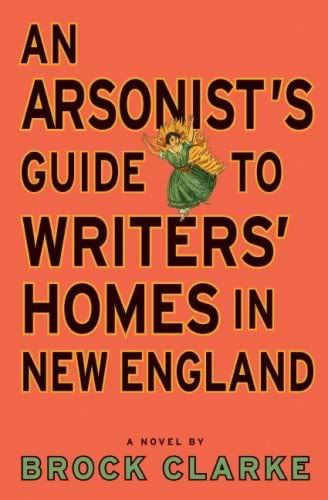
"She went to see my grandma...my other grandma," he said. "I have another grandma?" How to describe the way Christian said this? How to describe a five-year-old boy who finds out that he has two sets of grandparents and not just one? How to describe a boy who discovers that his father has for years and years lied about his own parents' being dead? And how to describe a father who doesn't think that, in killing off his parents, he has killed his children's grandparents in the bargain?

It's like Brock Clarke had a dream about a guy who burned down the Emily Dickinson house, went to jail, and had a lot of things happen that he can't make sense of. Following the plot is like being stuck in a dream of your own, with only a vague idea of how the ideas connect and how you got where you are.

The best part of this book is the main character, Sam Pulsifer. Sam is the most bumbling protagonist I've seen in quite a while, who gets himself into the weirdest situations possible but in such a fundamentally real way that it seems almost plausible.

That is to say, Sam himself is real (contrary to what another character will say somewhere in the middle), but his world is about as surreal as it gets. Bond analysts who write novels about other people's lives? The son of the people he killed shows up and steals his wife? Someone starts copy-catting his Emily Dickinson bonfire? Bizzare.

But unlike in Invisible Monsters, I think the characters and the motivations are realistic, and Sam's bewilderment at the events of the novel just help solidify that. He doesn't know how the wife-stealing happened, he's not even sure how he got his wife to marry him in the first place, so the feelings of the reader are confirmed by that of the protagonist himself.

Brock Clarke is headed for something amazing; this book is good, but not his masterpiece. I think even he would admit that this novel is better than his last one, Ordinary White Boy -- in fact, Clarke has his protagonist poke fun at that book in the middle of this one. Though he's not quite there yet, look out when he makes it, because he's going to be one of the best post-modern novelists out there.

Tuesday, April 15, 2008

Silly Rabbit, books are for kids!

You know what I miss? Reading silly young adult novels without being judged. Come on, we all read some really, really lame books when we were younger, or at least I did. But because it's spring, and I'm in a silly and nostalgic mood, I thought I'd talk about some of the books that stand out in my mind from those years when I read everything I could get my hands on...none of which I'd be caught dead reading now, but really loved at the time.

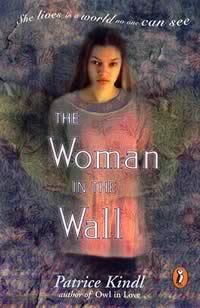
Woman in the Wall by Patrice Kindl
This was my favorite book for a year or two. Never mind that there's no way a seven-year-old girl could build a whole living space within the walls of her house only using the tools her dead father left behind, let alone that her family would be cool with this. But I get the metaphor, though I didn't at the time -- it's hard to miss the moth/cocoon connection later in the story, and this book is really too bizarre to be taken literally by anyone but the very earnest young reader I was.

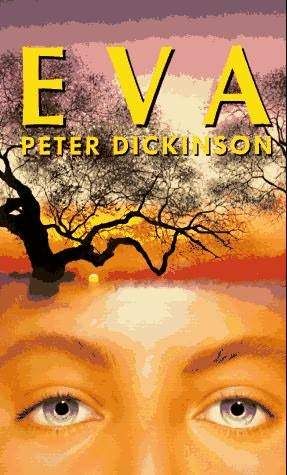
Eva by Peter Dickinson
I checked this book out of the library at least six times over the course of my pre-adolescent years. Now that I know it's not actually that easy to transplant a young girl's brain into that of a chimpanzee, it has lost some of its charm, yeah. It's probably not even scientific enough to be science fiction. Nothing is really resolved in the end, except maybe something about environmentalism and that we're all just animals anyway and probably we shouldn't be so cruel as to ignore animals lost in scientific progress. Or something. It's probably important to note that this was written in the 1980s.

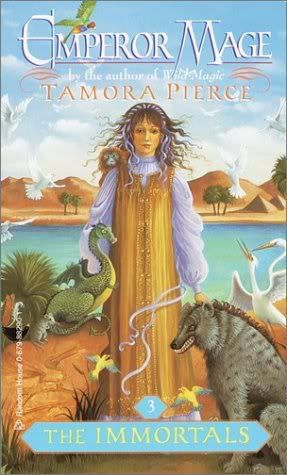
Emperor Mage by Tamora Pierce
Another book about a teenage girl who does something really, really cool. Sensing a theme here? This was my favorite book ever until I had the imagination beaten out of me by serious literary criticism and an interest in journalism. I mean, come on. The girl speaks to animals, has the ability to turn into one if she wants, and at some point resurrects the bones of dinosaurs to storm a castle. There's not much out there that can compete with that. In retrospect, I think I might have liked the story of Wolf Speaker, its prequel, better, but this is the one where she starts to shape-shift, which I thought was pretty amazing, without any of the creepiness of the Animorphs series that was kind of popular at the time.

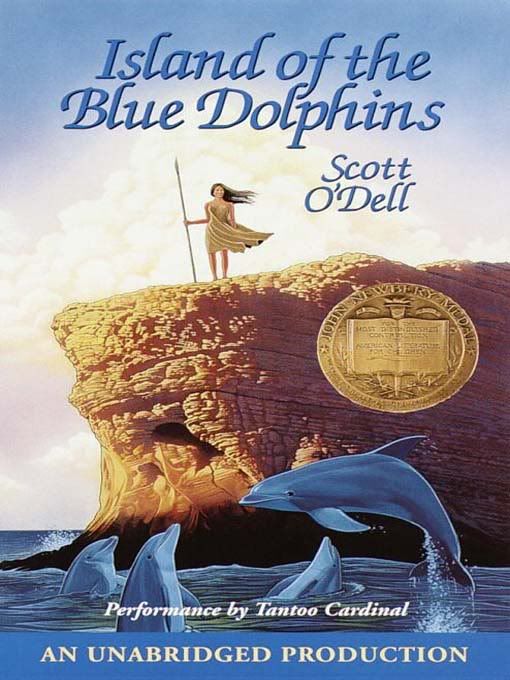
Island of the Blue Dolphins by Scott O'Dell
Wolf-Woman
by Sherryl Jordan
The Music of Dolphins
by Karen Hesse
So I was fascinated by survival stories, especially ones that involved animals in some form. I also went through a really long wolf-loving phase that reached its peak in middle school, so of course a book about a girl who was partly raised by wolves (in conjunction with the girl who can talk to them -- see above) was just about my favorite thing ever. But dolphins were pretty cool, too, as anyone who's ever bought a Lisa Frank folder can tell you, so that explains the others.

Monday, April 7, 2008

Live from the Library

So, I was thinking today (as I sat in the Buffalo and Erie County Public Library trying to look unapproachable) that there are probably very few book topics left out there that haven't been used. That in itself is depressing enough, since I would guess that "very few" is more like "none." But what's more depressing is that there are so few topics out there anyway, especially for fiction.

Leaving aside the greats and the classics, let's go with mass-appeal fiction. There are a few categories I can come up with off the top of my head:

Historical. Divided into:
a) thrillers in which a person overcomes the limits set by their time period and solves some mystery full of intrigue and murder. If the person is male, this is seen as unremarkable, though eccentric. If the person is female, every other character will remark on how it's unseemly.
b) romances. More on this later. Often these will be half history, half fantasy. See below.
c) pseudo-biographical, meaning the author was too lazy or too entrenched in the creative process to write an actual biography.

Romance. Oh boy. These are the worst. There are:
a) pseudo-pornographic. These exist solely to use raunchy metaphors and to embarrass women when they (the books, not the women) fall out of one's purse in public. Identified by their oddly similar and yet completely lifeless characters. Bonus points for checkered pasts, including run-ins with the law and previous sexual abuse, the damage from which is undone by a mind-blowing orgasm around page 20.
b) artsy-fartsy. These pretend to be literature (judging by the covers), but when you read them, it's the same old thing. Fewer metaphors and less embarrassing, but no less predictable.
c) Christian. More on this later. MUCH less sex. That is to say none at all beyond longing glances and passionate hand brushes.

Sci-fi/Fantasy. I am smashing these two together despite my better judgment, only because they are shelved together. These include:
a) romances in all categories, except generally Christian. Usually these will take place in either a castle in a made-up kingdom, or in some solar system where the planets are warring and there's a lot of death and zipping around in spaceships. Sometimes there are people who can turn into/talk with animals. That's always a plus.
b) "concept" novels. As in, wouldn't it be interesting if....fill in the blank. Like what if Homo Erectus didn't become extinct/the South won the war. Usually the idea is okay, the story is not.
c) pseudo-historical. Often these involve Arthur and magic, but sometimes there are cave people.
d) "prophetical." Generally preaching about what could happen if...fill in the blank. We don't stop global warming, we micro-manage the population, etc. Sometimes these are Christian (Left Behind), other times they are not (Brave New World, etc).

Horror. Often found in the mystery section, but also can be found in fantasy, sci-fi, or sometimes maybe romance. These almost all involve monsters, ghosts, psychopaths or other things that go bump in the night.

"Redemption" novels. Someone bad turns good. Usually this someone also overcomes an obstacle of some sort that was holding them back. Can be found in all other categories.

"Anti-redemption" novels. Someone bad tries to turn good, fails. Or dies while attempting to surmount an obstacle, which usually makes it a redemption novel, but not always. Can be found in all other categories.

Mystery. Someone solves something, often while in the midst of a historical/made-up world, romantic entanglement, or personal conversion (religious or otherwise).

Christian. Oh boy. Here's the run-down:
a) Historical. These are either in a time or place where Christianity is oppressed, or where everyone is Christian except the bitter man/woman/war vet/cowboy/spinster school teacher. Eventually he/she will find the Lord and all will be well, the kingdom saved, war ended, sheep sheared, etc.
b) Romance. Same as above, sometimes historical, but will always end with the bitter atheist finding love and the Lord at the same time. Usually there are children.
c) Sci-fi/Fantasy. With the exception of C.S. Lewis, these combine the worst of the two genres. I've never really run into a stereotypical sci-fi novel with life on other planets and such, but I can tell you that usually there are thrillers with odd breezes and evil spiritual forces that try to bring down the believer. Someone converts.
d) Horror. Again, from what I've seen it's usually more thriller-y than anything else, but I'm willing to bet there's Christian horror out there that I have missed. No doubt some of Satan's minions come stalk the earth, only to be overcome by a kindly priest and a couple who has brought each other to the Lord and fallen in love in the process of conquering evil. Sensing a theme?

My battery's about to die. But my point is, there's nothing left to write. Nothing. I'm willing to bet that every book, with the exception of the greats (eh, not even all of them), fits into these categories. Good luck finding one -- or writing one -- that isn't ;)
Saturday, March 29, 2008

Book Slut

Ha! I would so dump a guy if it turned out he hated reading or, at the very least, wasn't willing to hear me expound on Salinger every once in a while. Apparently, I'm not the only one:

http://www.nytimes.com/2008/03/30/books/review/Donadio-t.html

I know this is becoming more of a "highlights of the New York Times Book section" than a literature blog, but things have been crazy. I promise, more when I've finished The Grapes of Wrath, Sula, and all that stuff on Virginia Woolf's mental illness. I've also got some Harry Turtledove and An Arsonist's Guide to Writers' Homes in New England on the back burner, so look for those soon.

Friday, March 7, 2008

It just keeps coming...

Apparently Ms. Seltzer (of my last post), made up the foundation she worked for to aid gang members as well. Read the article here.

Well, at least this might take some pressure off the publisher...

Tuesday, March 4, 2008

Consequences, yes. Love? Not so much.

Oh man. I am so glad I am not this publisher right now. Why? Because of this.

For those of you who don't know, Margaret B. Jones wrote a very touching memoir about being the half-white, half-Native American foster daughter of a black family, including her involvement with gangs and drugs in South-Central Los Angeles.

Too bad her name is Peggy Seltzer, she's actually all-white, grew up in a well-to-do family, and made up the entire thing based on the experiences of friends who had been in gangs.

Yes, it's bad that The New York Times ran two articles (second here) on it and somehow managed to miss the fact that she was lying about her past. I really cannot believe that Mimi Read went to this woman's house, carefully examined her lifestyle, and somehow missed that maybe Ms. Jones wasn't all she said she was. But now they're covering the issue again and again, and they'll come out okay. This is probably the best book-related story all year, and at least it's selling papers.

It's bad, too, that editor Sarah McGrath spent three years working on this book and didn't know. But obviously Ms. Seltzer was a seasoned liar if she could fool two Times reporters and an entire branch of Penguin Group USA. She knew her story -- hell, she wrote a whole life story and appropriated it as her own!

Ms. Seltzer is essentially a combination of Jay Gatsby and Tom Ripley. And while the Times and Riverhead Books probably are kicking themselves over this whole thing (I would have loved to be a fly on the wall in that newsroom), really the only person to blame is Ms. Seltzer herself. Everyone remember James Frey? Yeah. Same deal.

Edit: Check out this article on yet another author who came clean about her fabricated memoir. Come on, people. It's still good if it's just a novel. Also check out this Slate article.

Monday, February 25, 2008

Dress Your Family in Corduroy and Denim

I am a person who feels guilty for crimes I have not committed, or have not committed in years. The police search the train station for a serial rapist and I cover my face with a newspaper, wondering if maybe I did it in my sleep.... I seem to have developed a remarkable perspiration problem. My conscience is cross-wired with my sweat glands, but there's a short in the system and I break out over things I didn't do, which only makes me look more suspect.

I'm about two years behind the bandwagon on this book. Actually, it might be more like three or four years, but regardless, at some point, David Sedaris was the hot new thing in the book world.

I guess I can see why. I enjoyed all of his stories, and while some of them were a little too neatly tied up and others sort of dropped off in the middle of nowhere, there's no doubt this man can write.

There's a hysterical anecdote in this collection about a tourist in Normandy stopping for directions and catching Mr. Sedaris drowning an injured mouse in a bucket. This in itself is not terribly funny, especially since the story is in the same vein as the "I-did-nothing-why-do-I-feel-guilty" pedophilia story. However, I cracked up at the line, "Oh...I see you have a little swimming mouse." I don't know why, but it probably has something to do with the image of an accented man in track pants and black loafers leaning over a bucket containing a swimming mouse and trying to make conversation.

All of these stories -- essays? -- are autobiographical, so though there is a lot of laughing at himself and his family, Mr. Sedaris's book also has a good dose of bitterness. There's the typical teen agnst in some of the earlier stories, as well as kind of a literary tirade against people who use the words "homosexual" and "pedophile" interchangeably in one of the later ones. Still, it's hard not to like a writer who describes the voice of reason as sounding like Bea Arthur.