Monday, February 25, 2008

Dress Your Family in Corduroy and Denim

I am a person who feels guilty for crimes I have not committed, or have not committed in years. The police search the train station for a serial rapist and I cover my face with a newspaper, wondering if maybe I did it in my sleep.... I seem to have developed a remarkable perspiration problem. My conscience is cross-wired with my sweat glands, but there's a short in the system and I break out over things I didn't do, which only makes me look more suspect.

I'm about two years behind the bandwagon on this book. Actually, it might be more like three or four years, but regardless, at some point, David Sedaris was the hot new thing in the book world.

I guess I can see why. I enjoyed all of his stories, and while some of them were a little too neatly tied up and others sort of dropped off in the middle of nowhere, there's no doubt this man can write.

There's a hysterical anecdote in this collection about a tourist in Normandy stopping for directions and catching Mr. Sedaris drowning an injured mouse in a bucket. This in itself is not terribly funny, especially since the story is in the same vein as the "I-did-nothing-why-do-I-feel-guilty" pedophilia story. However, I cracked up at the line, "Oh...I see you have a little swimming mouse." I don't know why, but it probably has something to do with the image of an accented man in track pants and black loafers leaning over a bucket containing a swimming mouse and trying to make conversation.

All of these stories -- essays? -- are autobiographical, so though there is a lot of laughing at himself and his family, Mr. Sedaris's book also has a good dose of bitterness. There's the typical teen agnst in some of the earlier stories, as well as kind of a literary tirade against people who use the words "homosexual" and "pedophile" interchangeably in one of the later ones. Still, it's hard not to like a writer who describes the voice of reason as sounding like Bea Arthur.

Sunday, February 17, 2008

To the Lighthouse by Virginia Woolf

A sort of transaction went on between them, in which she was on one side, and life was on another, and she was always trying to get the better of it, as it was of her...for the most part, oddly enough, she must admit that she felt this thing that she called life terrible, hostile, and quick to pounce on you if you gave it a chance. And yet she had said to all these children, You shall go through it all.

I really want to like Virginia Woolf. Honest, I do. I think she's a great writer, a brilliant thinker and critic and essayist, and that she does exactly what she sets out to do when she begins to write, with the exception of those disappointments all authors have with their finished products.

Still, I just don't like To the Lighthouse. I know that my enjoying the novel is more or less irrelevant in the grand scheme of things, as I'm just a piddly undergraduate living 100 years and 4,000 miles away from where Woolf was writing from.

The ideas are brilliant, and really more of what's in Mrs. Dalloway -- mourning the passage of time and lamenting the burden of life (can you tell Woolf was a teensy bit suicidal?). I suspect James will never get to visit the lighthouse, and that Mr. Ramsey will continue quoting "The Charge of the Light Brigade" without ever getting past that one line.

Is it okay to say the book is amazing without having actually enjoyed it? When I count down the criteria I consider necessary for a work to be "good," To the Lighthouse fits them perfectly. Strong theme? Check. Good metaphors? Check (though sometimes they are a bit obvious). Plot? Check -- kind of, but that's not a major one, anyway. Solid, fluent and fluid sentence structure? Check.

I have a feeling this novel(la?) is one of those books that will be taught widely in twenty years or so, even though I think it's relatively obscure right now. It has all the earmarks of a great work, but as of yet none of the attention of Mrs. Dalloway or A Room of One's Own. Still, for reasons I can't quite put my finger on, I just...couldn't like it.

Monday, January 28, 2008

Invisible Monsters

You can count down the facts and it's so depressing. I can only eat baby food. My best friend screwed my fiance. My fiance almost stabbed me to death. I've set fire to a house and been pointing a rifle at innocent people all night. My brother I hate has come back from the dead to upstage me. I'm an invisible monster, and I'm incapable of loving anybody. You don't know which is worse.

I think the only book I have ever read that was this messed up was Zelda's Cut by Phillipa Gregory. Even then, that story was only strange because the woman and her gay agent used to dress up like the same woman and then have sex, so it was basically like they were doing themselves. Only with two of them.

Anyway, Invisible Monsters by Chuck Palahniuk is so crazy I couldn't stop reading. It's like a tabloid -- you know it's crazy and trashy and whatever else, but it's just so bad you can't stop. It's like you've got to stick around to watch the train wreck.

And what a train wreck it was. Wow. In case you ever read this book, I won't spoil it, but suffice to say that Palahniuk has a real talent for painting a scene. I physically recoiled at some of his descriptions (a girl had her jaw shot off, and she shares the after-effects in graphic detail), but some things, like the opening scene with Evie, the inferno, and the rifle, are just incredibly beautiful in a really sick and terrifying way. Incidentally, the opening scene is also the closing scene, and it's even more fantastic the second time around.

I still feel like I missed something, meaning-wise, but that's okay. I'm okay with this book just being, like Palahniuk says, like a fashion magazine -- probably there's an artistic statement, probably there's a deeper meaning, but for now I'll just flip through, look at the crazy pictures, and wonder if I'm the type of person who can pull off the veil/silk negligee/rifle look.

Sunday, January 27, 2008

If she were my sister, I'd kick her out too


Is there anything in the world more boring than Sister Carrie? Well, probably, but the fact is that when a journalist goes to write a flowery novel about the tragedy and hardship of life, clearly all is not going to go as planned.

Theodore Dreiser flunked out of college and wrote for two newspapers in the Midwest before becoming a novelist. I have to give him credit for being an objective writer. He was probably a pretty good journalist, and he's not prone to using any sort of trickery to make the reader feel sorry for his characters. In fact, he hardly seems to care about his characters, especially Carrie, to such an extreme that when he attempts to point out how hard Carrie and Hurstwood have it, it's incredibly out of place and more annoying than heart-wrenching.

Dreiser at his best is fairly forthright. He really should have stuck with journalism, but the fact is that in Sister Carrie he cannot make up his mind whether to be strictly objective and naturalistic or to succumb to the kind of overwrought prose typical of the Victorian novel. He makes a distinct mistake in not remaining straightforward, and instead tries to be eloquent and whatever else, resulting in passages that are hilarious in their awfulness. Hurstwood's money-feathers were growing in? Come on.

That being said, I'm sure there are many wonderful things about this book. I just don't know what they are. Good luck trying to find them...

Friday, January 25, 2008

Randomly Trippy


I know this is a literature blog, but since I technically was reading an online newspaper when I found this, couldn't it count?

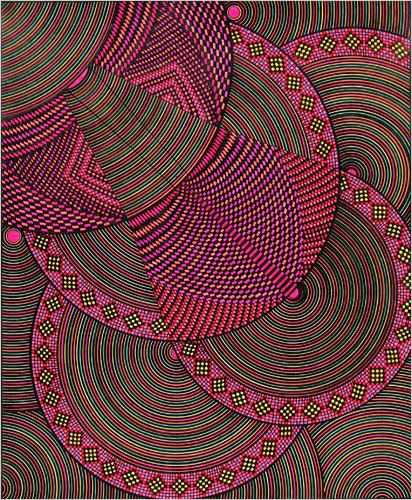
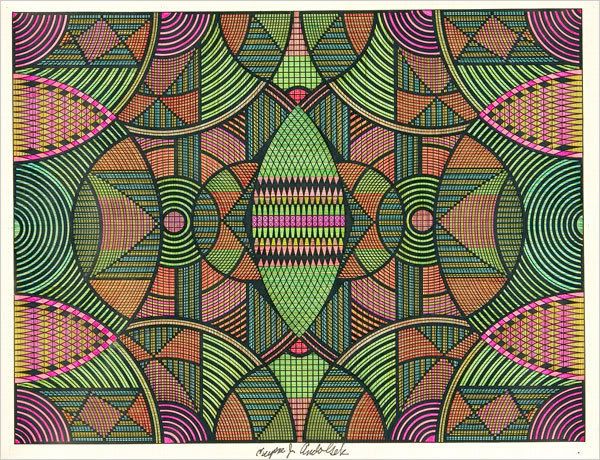
Apparently the creator of this piece is what is called an "outsider artist," usually a person with severe psychological disturbances that lead to amazingly original art. Some of it is trippy, some of it is disturbing, and some of it is just plain weird -- but all of these artists are supposed to be creating in these "bubbles" of expression and with an intense dedication to their respective visions. You know, like deer with huge eyes behind...tombstones?

This particular artist, Eugene Andolsek, was obsessed with the idea that he was going to be fired from his office job, but never was. Apparently making these "mandalas" with colored ink and graph paper (think those circles you used to make in seventh-grade math class when you were bored) helped to calm him down and relieve that fear. Since mandalas are used as a meditative device for Zen Buddhism and other Eastern religions, this seems to make some kind of sense, even though I have no idea if Andolsek made the connection himself. If you click on the picture, you should be able to see it in more detail. It's really incredible.

Anyway, doesn't literature do this? I mean, people like Kurt Vonnegut and Siegfried Sassoon were certainly disturbed, and Hemmingway drank for a reason. Some of the most original writers of their time were either experimenting with drugs or had some other kind of psychological issue.

J.D. Salinger certainly wasn't the picture of mental health, especially after he became famous -- and, as you'd expect, he got much more original after he basically retreated from the world. Early Salinger reads a lot like John Cheever, his closest predecessor, but who knows what he's writing now? I'm willing to bet it's either really great or incredibly awful, but that it's definitely different from anything else out there right now. Maybe true originality can only exist in isolation -- to an extent, I guess, unless you really can create art in a vacuum.

For more information on "outsider art," click here or here.

Thursday, January 17, 2008

New Year, New List

Forget about the holiday reading list. That was way optimistic. Here's the list of books I'm currently reading and that maybe I'll get a chance to write about sometime:

Sister Carrie by Theodore Dreiser. Not that Carrie is all that interesting on her own, but I think the purely naturalistic approach we're taking to it in my American Novels class should be okay...different than my last professor's view, anyway.

A Room of One's Own by Virginia Woolf. Virginia Woolf is brilliant, and this is an awesome read regarding women and fiction in all of their connections. Not that I agree that Jane Austen wasn't the literary genius Charlotte Bronte was (something Woolf argues for several times), but the general idea is fantastic.

Witness by Whittaker Chambers. The blurbs on the back of this book claim they are going to change my life. We'll see -- but the forward, written as a letter to Chambers' three children, is incredibly powerful and very moving. It's dense and kind of a tough read, but I think it'll be good.

The Name of the Rose by Umberto Eco. Apparently he died recently? Anyway, had this on my shelf for about a year and haven't read it yet, so I decided that's my new bedtime read. Don't expect me to finish this one anytime soon -- it's good, but I have about 700 pages to read for Tuesday, so this one might be put on the back burner.

There's the new list! I had better make it allllll the way through this one...

Sunday, January 13, 2008

Cleaning House

Ugh. It really sucks, getting rid of books. I save books for the same reason my grandma saves tinfoil and those little tables that come on takeout pizza -- because someone might need it someday.

I have books on Irish storytelling that I hate, because it's total "shamrockery," but I keep them in case someday I overcome the hatred of everything Americans think is Irish and actually read them. Also, someone who knows I lived in Ireland for a while might, one day, ask me for a book on Ireland, and I'd be really embarrassed if I didn't have one.

I have one rather scandalous book which I will not read in public, but still love because the overblown dialogue always makes me laugh. This, however, is separate from the trashy romance I keep because I bought it on a road trip with a friend and we spent three hours reading it out loud and laughing.

I have too many books on Shakespeare. I have one giant book that contains all the "necessary" plays, but I don't actually know what those plays are, so it's flanked by backups of my favorites. I also have two plays that I don't even like but were rejected by a friend and I had to take them in.

Since I'm moving and don't know where or when these books can finally come out of their boxes, some of them have just got to go. The multiples, I can deal with -- no one needs three copies of The Grapes of Wrath. It's also time to let go of some of the textbooks I was keeping just because they cost me a LOT and the bookstore wouldn't buy them back. Still, I'm going to miss seeing that trashy romance stashed next to The Irish Story and one of four copies of A Midsummer Night's Dream.