Sunday, March 29, 2009

Movin' Out

Hey everyone!

It's official, we've moved! Come join us over at Wordpress:

http://literarytransgressions.wordpress.com/

~ KT

Monday, March 2, 2009

On being eaten by office supplies

If you click above, there's a larger image where you can actually read the insights on those Post-its -- things like 'KING IN THE MOUNTAIN' and strings of numbers that look oddly Da Vinci Code-esque.
See this, guys?

That's what my Tolkien essay looks like. Post-Its a-go go. They have taken over my room, my life, and my books. Bear in mind that the above picture doesn't include the three stacks of books I have yet to flag. Incidentally, that's pretty much why I haven't updated lately...but I do have news!

First, preparations are underway for Literary Transgressions to make the move over to Wordpress! Why, you ask? Because, in the words of my lovely co-bloggist, "It's so pretty and shiny!" And she's right, you know. There were promises of a custom header if we made the transfer, too, so look for that to come soon.

Second, there will be simply millions of posts soon. I promise. Mmhm. I have one drafted right now about Tolkien and contextualization, I have one in the back of my head about the King in the Mountain archetype, and I am sure there is going to have to be one sometime about Stardust, both in the novel and film forms (probably a comparision of, actually).

Third, ummmm...well, I guess there isn't really a third, except to say that this week is my final week of classes. What does that mean for you? Only that I just may have more flexibility and time to post in the future, lucky readers :)

Tuesday, February 3, 2009

The Shift from Square to Smart

When I first started reading Girlbomb: A Halfway Homeless Memoir by Janice Erlbaum, I’ll admit I felt more than a little bit like a goody-two-shoes. Girlbomb tells the story of Erlbaum’s misspent youth from the moment she walked out on her mother at age 15 through her life and times in a shelter, a group home, back at home and out on the streets, all the while cracked out like only a teenager in Washington Square Park in the late 1980s can be. I meanwhile grew up primarily in an affluent upstate suburb where I insistently went to school everyday, actually once made a rather inane New Year’s resolution to say no to drugs (I was in middle school, give me a break), went to a nice college full of nice girls, graduated on time and pretty promptly got a job. I was even wearing a jumper the day I read it, for Pete’s sake. I felt distinctly square.

But as I continued to lurch my way through Erlbaum’s memoir, that feeling changed. I stopped feeling like an abject loser and realized how wholly sad her story was. It was the tale of a life disrespected and utterly wasted. On the surface, Girlbomb might well be telling the story of a crazy 1980s teenage-hood in New York City, but what really got through to me was just how many moronic and pointless decisions one person really can make.

And nothing bad truly happens to Erlbaum in the book (aside from the obvious drugs, sex and alcohol things that she herself chooses), a fact which makes her decisions all the more pointless. This book does not moralize or hint that these choices were perhaps bad ones and thank heavens she has now reentered society as a respected author. There is no climactic moment where she realizes the error of her ways or dies in a blaze of glory. Instead, Erlbaum traipses through the 1980s drug and club scene of downtown New York and nothing happens. She isn’t arrested, she never dies (okay, she comes close, but that isn’t surprising considering the amount of coke we’re talking about here), she doesn’t contract any life-changing and/or horrifying diseases, she doesn’t get beaten up by her dealer and the toughest thing she has to deal with is a curfew she deems cruel set by her remarkably lenient mother and the fact that her two best friends like each other more than they like her.

But the overarching message isn’t about pointlessness or hardship. Rather, my first impression was dead on. All through her crazy antics and drug-induced freak-outs, Erlbaum is undoubtedly saying “yeah, this was a folly of my youth, but, damn, don’t you think it was a cool folly?” The book is filled with an undertone of ineffable coolness that just comes off feeling a trifle forced and hardly true. No, Jan, it wasn’t a cool folly. It was just stupid.

And that is what the reader takes away from Girlbomb: Erlbaum needlessly, idiotically and senselessly wasted her life. The sheer stupidity and pointlessness was what ended up really getting to me. The book calls itself a “compelling story,” but to actually be compelling, I think something dramatic followed by some kind of death or turn-around would really have to happen. The entire book comes off as pointless, since by the end of it, our dear Janny has set herself back on the road away from drugs, but not in a particular redeeming or dramatic way. One minute, she’s shouting profanity at her lover and then trying to make up with her boyfriend and the next she’s just out of the bad stuff and living in her own apartment (paid for by her dead grandmother) as she goes off to college. It’s all a trifle jarring, bizarrely more so than all the shocking nonsense that goes on before that moment, and the book just ended up confusing me more than anything else.

Click here for the first chapter read by the author herself, courtesy of Poets & Writers podcast.

Tuesday, January 27, 2009

Relevant Writing

In light of the recent discussions we've been having on this blog and in the comments about "fluff" books and chick lit, I thought I would link you all over to this extremely intelligent viewpoint on the matter written by Joanne Rendell over at the Huffington Post.

In all our discussions here at Literary Transgressions about "fluff" and chick lit, we have yet to breach what might perhaps be the most basic aspect of the debate: gender. As a Smithie, I know it sounds woefully cliche to bring this up, but it seems to me that in all our ponderings about what makes chick lit today so derided and simply not respected, we have failed to look at the fact that most chick lit authors are women. Is there something more to be said there or is chick lit disrespected for other, more stylistic reasons?

Hot Town, Super in the City

Super in the City by Daphne Uviller is (Devil Wears Prada aside) my first true foray into what society at large has not-so-lovingly dubbed "chick lit." I must say that I was more inclined than most to read this book and even more inclined to like it, having become e-quainted with said author over the past few months (she just seems wonderful). And yet...?

The book's main flaw is its very genre. Chick lit is by nature infuriating with its rampant escapism, its unattainable alternate realities and, at the gushy heart of any chick lit book, its mythical One striding about in a very manful manner. It is nice to delve into and even disappear into this relatively tidy little world where you just know everything is going to eventually work out. It's peppy and comforting and wonderfully distracting, but it is not real. The moment you lift your nose out of any chick lit book's light pages, you immediately crash. On the cover of this book, Elizabeth Gilbert compares the novel to candy ("intelligent candy," mind you) and I think that is very much accurate of the genre. You get this happy little sugar rush reading and then, once done, you crash back to reality with very little residual buzz to show for your time. It's disheartening even as you were moments ago reveling in your sunny little chick lit world.

However, setting the main constraints of the genre itself aside, the book was not in and of itself at all bad. In fact, I just plain old liked it! There isn't anything really deeper to read into that or anything to really comment on why or why not, I just liked it. The book is the simple, friendly little tale of an extremely likable woman with the fantastic name of Zephyr Zuckerman. She merrily skips through the novel, going through a range of emotions and catastrophic situations before finally getting her perfect, rainbow over Manhattan happy ending. It's great.

Most simply, this book was a nice little moment of escapism and one that is not so far-fetched as to really hurt you when you come crashing back down from chick lit land. Ms. Uviller's writing style is utterly fantastic: intelligent without seeming pretentious (although, as a Yale graduate, she would have every right to be so), funny without hitting you over the head with the punchline and wonderfully real-feeling, even in its moments of greatest unreality. Zephyr honestly comes to life, as do the people she encounters along the way. I have absolutely no idea what other genre Zephyr might have more happily fit into (although judging by her preoccupation with romantic fantasies of the mind perhaps chick lit is the right place for her), but it might have been nice for Ms. Uviller to try out her debut writing chops on something equally shiny, equally nicely written but perhaps slightly more substantive.

Note: I actually wrote this review some weeks ago since I was beneficently given a review copy and, since then, I have slightly revised my thoughts on the book. This book stuck with me a surprisingly long time and I still find myself thinking about it sometimes, weeks later. While no one is going to confuse Super in the City with high literature, I must say this was a good, thoroughly likable book. Please do read it in your spare hours! It goes quickly and is quite an "upper."

Wednesday, January 21, 2009

Valley of the Dolls, not the chicks


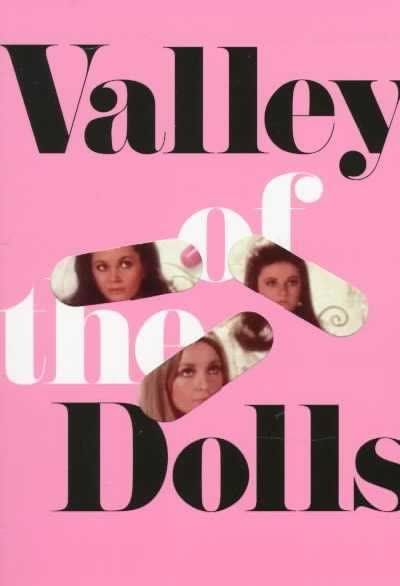
At first, I wasn't sure why Valley of the Dolls wasn't included in chick lit week for my literature course. After all, it has a pink cover, follows three young women through various career arcs and romances, and has enough sex to qualify. Plenty of handsome men and beautiful girls to go around.

But from the first chapter, I knew that Valley was in a category apart for certain. Though Anne, the main character in the first part of the book, is beautiful and pursued by a millionaire, Jacqueline Susann sets a tone in the beginning that makes the reader feel as though Anne's life is much more real than any chick lit protagonist could ever hope to be. Though a millionaire wants to marry her, she lives in a singularly squalid one-room apartment; and though her boyfriend seems to be a sweet, unremarkable young man, it is soon revealed that he is, in fact, connected with a lotof money gained through very dubious means.

We discussed chick lit a lot in our course, at least during the class assigned to it, and we came to the conclusion that though they are regarded as 'fluff,' they do deal with important issues such as body image, female self-worth, shopping addiction, and the angst inherent in being a single 30-something in London. Still, a lot of us were left with a vague sense of contempt for the genre, though we were unable to articulate it when the professor asked, 'How can you call this fluff if it deals with these issues?'

But Valley of the Dolls answers his question clearly. I could never call Valley 'fluff'; though it was popular, and therefore it has the stigma of common approval, it is also a complex, raw examination of show business, women, relationhips, and what people will do to protect what they think is valuable.
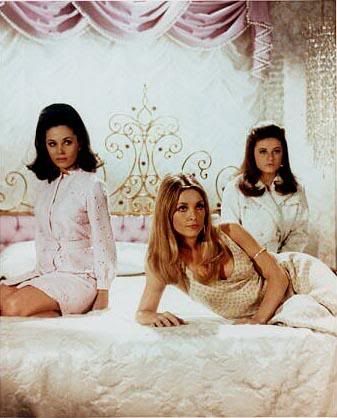
Valley deals with addiction (mainly to pills, called 'dolls'). It deals with body image (all three of the characters make livings off of their bodies). It deals with being single, or rather not being able to get who you want, until you finally get them and realize it's not enough. It deals with the horror of having to take six Seconal and still not being able to sleep; it addresses cancer, insanity, fame, fortune, love and adultery.

And it does it all at the same time.

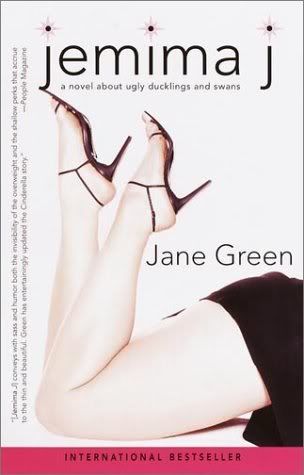
Chick lit can only deal with one issue per book, sometimes per series. Jemima J is about body image. Full stop. It doesn't bother to delve into the disturbing fact that Ben only likes Jemima after she's skinny. Confessions of a Shopaholic and the rest of the series is about shopping addiction and debt, as well as the possible involvement of the financial industry. Slightly more complex, but as everything always works out okay for Becky Bloomwood, you can hardly say this is an intense examination.

Bridget Jones's Diary does deal with a few more issues, including judging by appearances, trying to find self-worth in the midst of a society that tells you you're worth nothing without a husband, the falsity of tabloid journalism and the demerits of weighing under 9 stone. However, Bridget Jones is the best of the bunch, and everything ends with a happy ending that doesn't quite ring true.
Valley, with all of its glamour and glitz, never feels false. Despite the blockbuster sensationalism of the subject matter, Susann has a firm grip on what feels real and what a simply realistic ending would be, based on the character's pervious actions and tragic flaws. Pessimistic, possibly -- but then it definitely escapes the dreaded moniker of 'fluff.'

Friday, January 16, 2009

What goes around comes around

When I said earlier that Edward Rutherford’s epic The Forest didn’t deserve its own post, I was just plain wrong and lumping it rather unfortunately in with other books I read towards the end of 2008. Having now finished the volume, I can say that, more than Rutherford’s other books, this one most certainly deserves its own post. I say this not because The Forest is so far superior to its compatriots, but because this one was so much more unreliable in its quality.

I have without reservation been merrily recommending Edward Rutherford to just about anyone who would listen since the latter half of high school. “Read anything by him,” I would say excitedly, “It will all be brilliant!” While that might well be the case with both London and, perhaps even more truthfully, Sarum, I am very disappointed to report that Mr. Rutherford lost his swing in this particular tome. The Forest tells the story of, simply put, the New Forest located in the south of England. As with all Rutherford novels, this one successfully covers centuries of history by stopping every hundred years or so in various time periods and examining the people who are found there. Another Rutherford trademark is unsurprisingly present in The Forest: he follows five or six select families in the given region as he skips about through time, checks in with their descendants and makes little winky mentions of previous forebears as he goes through time.

This format may sound at best like a tedious exercise in attempting to bring the past to life for the ordinary reader (who cannot really be expected to really feel for someone living in 1614 without personifying 1614 with Alice Albion, for example). However, tedium is simply not a part of the Rutherford formula. Despite the book’s simplistic formula (and Mr. Rutherford unfailingly follows it in every chapter), Mr. Rutherford possesses the unique ability to quickly sum up a time period (quite accurately most of the time), introduce/define some characters and get on with the plot in such a way that the book never lags. At least, that is the goal. And one that he admirably attains in his previous works (the aforementioned Sarum and London among others).

However, he does not truly make it work in this book. The first half of the book is charming and interesting as any other Rutherford novel, but as he enters the seventeenth century, his ability to make it all interesting apparently just deserts him and the reader is dragged through an increasingly uninteresting and distended piece about the Stuarts, the unfair trial of Alice Lisle and Oliver Cromwell. One can easily see that Mr. Rutherford did some research, discovered Alice Lisle and then thought it would be just wonderful if he could incorporate her into his novel, which he did at much detriment to the novel itself. The story of Alice Lisle is quite interesting on its own simply because of the extreme injustice done to poor old Alice, but the whole retelling just comes off as forced and more than a little dull in Mr. Rutherford’s attempts to force his families into the mix. I admit I struggled woefully for weeks through that unending chapter about the seventeenth century and emerged from it liking Mr. Rutherford and his book rather less and hating the Stuarts and Oliver Cromwell about equally as per usual.

That said, Mr. Rutherford does manage an impressive save after the unfortunate “Alice” chapter by bringing the late eighteenth century and a Jane Austen-like chapter into play directly thereafter (“Albion Park”). One of the things that makes Mr. Rutherford's book so interesting is how his tone changes to match the time period he has entered in every chapter. While there is a calm, descriptive even-handedness pervasive throughout the book, Mr. Rutherford is also very much aware of literary styles of any given time period and relishes in morphing into them a little bit. He disappears almost entirely in Jane Austen for his “Albion Park” chapter and it is a very enjoyable exercise.

The book lags a little bit in the chapters after “Albion Park,” but he never truly loses himself as he did in the seventeenth century. His Victorian section seems a little pointless and plotless (more of a character study and familial check-up than anything) and his tacked-on 1920s and 1980s narratives make you wish the book had just ended in “Albion Park.”

Despite these shortcomings, the book is still an impressive feat of historical research and this is an area Mr. Rutherford clearly loves. I would more readily recommend his other, earlier novels, but this one was good enough. Even if he somehow lost his magic touch to make everything fascinating, the book is still an interesting study in history and how a place changes over time. This may not be enough to tempt most readers into taking on this epic (indeed, I might not have bothered if I had known that it was not Sarum-like in its excellence), but it is a great accomplishment nonetheless.

Sunday, January 4, 2009

Take Out the Trash Day

It's come to my attention that I have four books sitting in my "shelf," all of which I have spent considerable time with over the past month, and all of which I was planning on blogging extensively about. However, I have recently written papers on all of them and am still a little burned out. So, in the spirit of the new year, I have decided to write one short post summing up all I have to say, and then completely refresh my shelf.

Lady Audley's Secret is on there first, and was originally meant to go with The Great God Pan. Lady Audley's secret is about a young lady named Lucy Graham who appears as if from nowhere and marries a baronet at least 20 years her senior. All is well and good until her new step-nephew arrives with a friend in tow. This friend disappears, presumably murdered, and the nephew goes on a hunt to discover the truth about Lady Audley.

The Great God Pan is about a doctor who punches a hole in a patient's head in an attempt to make her see what is 'beyond the veil,' or what he calls the Great God Pan. The woman becomes an idiot. 20 years later, reports of mysterious deaths in London lead several men to investigate the results of this old experiment. Their explorations lead them to one Helen Vaughn, a young woman whose origins are hazy.

The main things these books have in common are young women who succeed in society, and men who die or almost die as a result. Also, men who investigate with the intention of taking down these succeeding women. I meant to explore the idea that while more scandalous than earlier novels, what with their emphasis on murder and sex, they are in essence socially conservative. No woman who rises under false pretenses, or by using unorthodox methods, is suffered to live. Therefore, the overarching message of these books is that society will bring down any woman who attempts to use her sexuality or any other power within her means to rise in society is a threat, and must necessarily be brought down. Sounds pretty conservative to me.

The Coral Island and Alice's Adventures in Wonderland also went together for me, and while I was going to write a big long post on identity and consumption, what I am going to say is merely that people love food, people define themselves through what they will and will not eat, and certainly this is even more true for children, who are just realizing who they are or who they want to be.

If you read Alice carefully, you can see that she is often refused food (the tarts, tea with the Hatter and Hare) in an attempt to teach her self-restraint, and any time she does eat, she is thrown into a state of physical and emotional confusion. In the beginning when she drinks the potion and eats the cake, she is so thrown by her dramatic physical changes that she cries, wonders who she is, and essentially loses her identity.

For the boys on Coral Island, food is a way to reassert their British identities. In redefining the coconut-juice and breadfruit they find on their island as lemonade and wheaten bread, they show their unwillingness to part from the familiar, and in rejecting the notion of cannibalism as practiced by the natives, they make the natives an "other," opposed to the Crown and who must either be conquered or converted.

So there you have it. All I was going to say about four books, in one simple post. Relatively painless, yeah?

Tuesday, December 30, 2008

And guess what, Jane? Fairy tales aren't real.


Hey readers! I have finally got around to a book review -- well, a rant/book review, in letter form, a la the Mercy review from a while back. Enjoy~

Dear Jane Green,

How could you? How could you write a book like Jemima J?

I have to assume that you are an intelligent woman, because, in general, writing is hard, and writing a novel is even harder. You have somehow managed to come up with an okay plot, some decent characters, and even played around a little bit with narration and perspective. You're also British, which, as we all know, makes you at least sound smarter than us kooky New-Worlders.

But you have obviously missed the memo on some very important facts of life, and I find myself in the awkward position of both wanting to kill you and wanting to take you aside and have a nice, deep heart-to-heart with you. Since I obviously can't, I will instead have to settle for writing you a cyber-letter, a letter which you will never read, but will make me feel infinitely better for having gotten my incredible anger off my chest.

So, Jane (can I call you Jane?), here are just a few of the things I feel you should know:

1) Not all fat girls are funny. I see why you would like to think so, Jane, and we would all like to think that everyone has one redeeming factor that could make someone fall in love with them, and for fat girls, it's easy to say that they have excellent personalities, or are sarcastically funny. In fact, it's almost realistic, because so often people who are insecure use sarcasm or other forms of humor as defense mechanisms.

I thought you were really, really close to getting to the 'some people are just mean' idea, as well as the 'just because someone's fat doesn't mean she's a good person deep inside' theory, when you introduced Jenny the surly PA. But as it turns out, Jenny is a delightful person, who also nabs the dream guy. Too bad, Jane. Too bad.

2) Not everyone would be striking if they just lost some weight. Guess what, Jane? I know you're beautiful (nice picture on the jacket, by the way), but here's a news flash: some people are just dogs. There are no two ways about it. There are plenty of skinny, ugly girls out there, plenty of average-sized ugly girls, and plenty of people who are just kind of middling. Paul the graphics dude drawing in some cheekbones on Jemima is not enough to convince me that she would, in fact, be a babe if she lost 90 pounds.

And shame on you for telling fat girls that if they would only exert a little effort, lose a little bit of weight, they'd be turning heads in Starbucks. That is so untrue, I can't even express to you how completely false it is. It's almost as outrageous as telling women that if they just lost a stone or two, they would finally get that promotion, those designer clothes -- which you also seem to think will actually happen, judging from your novel.

3) Not every girl gets the guy. Jane, have you ever heard of a spinster? That's right, that's a woman who never marries, usually because no one wanted to marry them. Sometimes they have a terrible past, like Miss Havisham, but more often than not they are just women who were left over when everyone else paired off. Just because some chick loses weight does not mean she is going to get the guy of her dreams, and it is just so wrong of you to suggest that someone should change everything about herself on the off chance that the guy of her dreams will fall in love with her.

For every Jemima, there is an average girl somewhere, pining after some gorgeous guy who will never notice she exists. Eventually, said average girl will settle, not for the hot young TV presenter, but for some balding 40-year-old man. Or maybe for an overweight World of Warcraft aficionado with Cheez Doodle stains on his t-shirt. But Jane, she will settle, or buy thirty cats and live alone in an apartment for the rest of her sad, lonely life. Those are her choices.

4) Not all almost-virgins are good in bed. Let's be real, Jane. There's a reason virgins are virgins. It's because either no one wants to have sex with them, or they're so freaked out about the possibility that they might blow it (not in that way) that they put off sex as long as possible. Or they're religious, but let's put that option aside for the moment. Either way, the first time one of these girls has sex is going to be an awkward, messy, possibly painful experience. It is not all doing the reverse cowgirl on some mind-blowing hottie, whom they will later shag on a desk, a fur rug, and in an elevator. Life is just not that fair.

5) The Perfect Guy isn't ever perfect. Now, Jane, I know what you are thinking. You are thinking that I'm totally wrong, because you have met your knight in shining armor (sorry, armour, to you) and he is wonderful and fantastic and everything you dreamed, which is why you dedicated your book to him. That's nice. But I don't believe it for one bloody second.

You have created this character, Ben Williams, and he is certainly delightful in every way. Ben is too delightful. Ben doesn't even have the flaws requisite in a Nora Roberts character. Ben never leaves his socks on the floor. Ben collects original vintage political cartoons. Ben drinks Becks from the bottle, wearing an impeccable suit and watching the news. Ben is adorably awkward, and actually utters the phrase: "Er, yes. Quite." Ben the deputy news editor is so hot every woman in London is absolutely gagging to be with him, yet he remains blissfully unaware of his hotness and is just waiting for the right girl.

But what is most important in our darling Benjamin's life? Becoming a BBC newsreader, and hanging out with the junior reporters on staff. Oh, and being incredibly sweet to the fat girl. Whom he will later shag, but only after she's turned into the babe of his dreams.

The above are just some basic things I think you should be aware of, dear Jane. You are a good writer -- hell, I stuck with you for 300 pages while you blithered on about Jemima's weight loss regime and how amazingly sweet Mr. Deputy News Editor is. I think it's cool that you played off of the little Brad/Jennifer thing -- I am assuming Brad Pitt and Jennifer Aniston were together when you wrote this? At any rate, even if it's just a coincidence, I enjoyed it.

And, to be fair, I enjoyed that Jemima lost the weight, I enjoyed that she got the guy, I enjoyed the makeover, and I enjoyed that she was happy with herself. What I didn't enjoy was the letdown when I closed the book -- the letdown as I realized that life wasn't actually like this, that no one loses 90 pounds in three months, that a guy like Ben Williams would never notice Jemima J, and that not every girl is a diamond in the rough.

So thanks for giving me four hours of escape to a world where anything is possible, but maybe next time you could get a tighter grip on reality and possibly write a book worth rereading.

Thanks,
Disgruntled Reader

PS: Americans get sarcasm fine, thanks. There's no need to be snarky about it.
PPS: Are you aware that your main concept is a lot like Jennifer Weiner's in Good in Bed? Just curious.

Tuesday, December 23, 2008

'Tis in my memory lock'd...

I’ve read a few books in the past month or so, mainly topping off half-read books that have collected dust over the past two years. While none of them seemed to really merit their own post, I sat and tried to think of some meaningful common theme or thread that would connect them and thus allow me to post about all of them at once. I’ll give you their titles and you tell me if you can come up with one: Peter the Great: A Biography, The Museum Guard and The Forest. Anything? I was stuck in a similar situation of no continuity. The best and most pathetic result of my thinking was “history.” The common thread of history. Pitiful, I know.

Or is it really so? Forgive me, but I would argue that the common thread of history connects much more than three books pretty obviously about that subject. The Forest by Edward Rutherford aptly illustrates this perhaps obvious point. It is an epic work of historic nonfiction that fascinatingly traipses through centuries of English history focused in and around the New Forest in southern England (near Salisbury, the setting of one of his other wonderful and similarly formatted books, Sarum). The book moves through the centuries briefly pausing every two hundred years or so to look in on the evolution of a given place, a few chosen families and the country’s broader history. The book is comprised of little snapshots and while each chapter is equally interesting and Rutherford undeniably excels at quickly creating fully-formed characters one can’t help but care about, the broader point the book makes is that while we all go about our lives and seem so unrelated and so different, a common history unites us all, and oftentimes even more common and closer than you think. Rutherford makes the subtle point that history is more important than just for studying; it shapes who we are and who we become as a people, as individuals and as families. Even without active knowledge of the past—a mode in which most of his characters blithely exist—history undeniably moves us.

The Museum Guard by Howard Norman concurs with the point that history is very much an active presence. His book is more character study than novel and tells the story of DeFoe Russett, a museum guard of a small, local art museum in Halifax called the Glace Museum. DeFoe’s simple existence is utterly unraveled (seriously, our even-keeled art lover is by the end of the book to be found in prison) when a certain painting arrives at the Glace Museum. The painting depicts a woman standing outside of a hotel in Amsterdam holding a loaf of bread and it proceeds to change all the character’s life in ways big and small. The book broadly deals with the onset of World War II, jewishness and how art can affect our lives, but DeFoe is most moved by two things: the premature death of his parents in a local zeppelin crash and the strange transformation undergone by his lover inspired by the painting. Both these events are deeply rooted in history: the zeppelin crash that killed his parents becomes part of the local history, dehumanizing the event for DeFoe even as he most sorely still personally feels the aftermath, and his lover retreats from reality into the historical moment portrayed in the painting. History is another character in the book; the common local history, the feeling throughout the book clearly felt by all the characters that they are witnessing history as Hitler begins his rampage through Europe and the actual withdrawal into history by DeFoe’s lover all reiterate the point that history is no passive afterthought. History is everywhere, informing decisions, moving action and forcing retrospection.

Of these three books, perhaps no protagonist (or subject, in this case) most sorely feels the pull and judgment of history than Peter in Peter the Great: A Biography by Lindsey Hughes. Of all the people in the books, Peter is by far the most aware of history as an entity. Rutherford’s characters primarily simply exist, at best only partially informed of what has come before through folklore or rumor. Norman’s DeFoe is primarily uninformed and only speaks to the history that he himself has experienced. But, as Hughes argues, Peter the Great was extremely conscious of the importance of history and strove constantly to make sure he was remembered properly and regarded well in the annals of history that came thereafter. Not only that, Hughes makes the argument at the end of her book that while Peter himself was involved in his own making of history, the Romanovs who held the throne after him were very much aware of the political importance and usefulness of history, using Peter’s memory and image well into the twentieth century to prove to their followers (and detractors) how good they really were for Russia. History was seen and used as a legitimization of the present because it still felt so relevant and so real. History was not something mustily confined to books no one read. History was real and it was everywhere.

Call this review an attempt to proselytize by a former history major, but history is too often mistaken for something unimportant, easily forgotten and rarely studied. I believe it is far more relevant to today than most people would give it credit for. As Rutherford shows through his study of the centuries, history is undeniably everywhere, even in the commonest or simplest story. Every moment is history. Life is entirely made up of interlocking disciplines and to forget any one among them, history particularly in my opinion, or to dismiss any one as irrelevant to the present, is not simply lamentable, it is inexplicable. Anything can create a connection and history does daily.

Sunday, December 21, 2008

Power to the Sisterhood -- I guess?

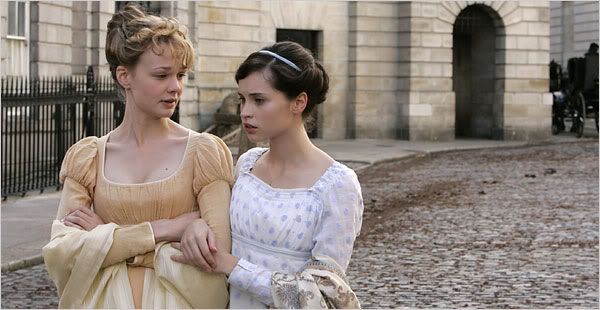
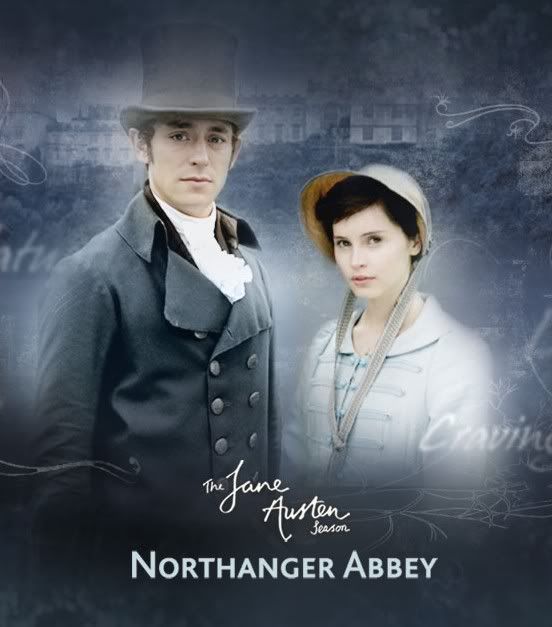
Isabella Thorpe and Catherine Morland in the BBC's production of Northanger Abbey, courtesy of The New York Times
Yep, I am a failure. See what happens? You give me a co-blogger and I get lazy. Anyway, trust me, I have been doing lots of literary things, just nothing that's made it on this blog...until now.

I know this is not going to win me any friends, but I am becoming less and less a fan of feminist criticism. This is not to say that it's entirely without merit, or that feminist critics are not really intelligent, educated people. What I would like to point out, though, is that because most feminist critics are women themselves, they're more apt to project, or to see what they want to see in the books they examine.

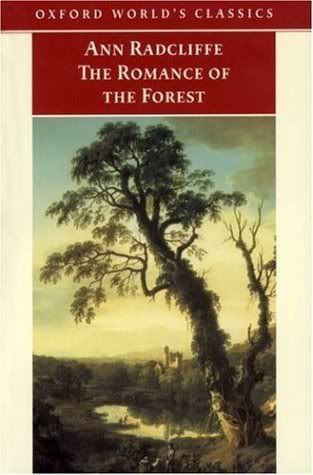
Take The Romance of the Forest, for example. This is a great story, by one of the first popular woman writers, and clearly Ann Radcliffe must have been somewhat independent in her own right to even be a female writer. The main character in Romance is Adeline, a young lady who has been separated from her father, separated from her foster family, is being chased by an evil marquis, and who is pretty sure her ain true love is rotting in prison awaiting his death. So you can see how there is a lot of opportunity for Adeline to step up and assert her strong-willed womanhood or whatever.

Claudia Johnson, in her book Equivocal Beings (which is actually brilliant, except for this one point), argues that "Adeline behaves like a pretty good man, at least when her 'glowing charms' aren't in the way," further saying that Adeline and Theodore essentially 'trade off' being tearful and valiant at various points in the novel.
While it's true that Theodore has some tears throughout the novel, they are mostly when he is in prison being visited by his sick father. It's more standard for the male lead to be brave in this case, but when confronted by the prospect of death within the hour, along with a sobbing father, sister, and lover, I think pretty much any man would break (or could without being judged, at any rate). And let's remember that Theodore has valiantly rescued Adeline about twelve times before this point.

Adeline, however, is not valiant. Ever. Possibly when she finally breaks and tells La Luc she's in love with Theodore could be construed as heroic, but really, since she doesn't even know why that's important, it's not that heroic (hopefully that's not a spoiler...). She weeps and wails and moans and faints at every opportunity, including when she and Theodore are confronted in an inn by the Marquis' troops and both their lives are threatened. At some point, she actually hinders Theodore's usefulness, preventing him from defending them against the soliders by throwing a faint.

To interpret the book in a way that made any sense to me, I was forced to read Adeline not as a character, but as a plot device, or a catalyst, a passive center around which everything revolved (much like the eye of a hurricane). I should hesitate to take Claudia Johnson on regarding this point, but I think she's mistaken.

That's not to say she's the only one. Constantly, discussions in my literature class will revolve around "strong women" in novels where such women simply don't exist. One memorable discussion revolved around Isabella Thorpe, a character in Jane Austen's Northanger Abbey. Isabella and Catherine Morland, the main character, are both in Bath for the marriage market, but while Catherine sets her sights on Henry Tilney and sticks with him for the duration, Isabella plays two or three men against each other and, I believe, ends up losing both of them.

One girl in my class argued that Isabella was a strong woman, playing the marriage market to her own advantage and going after what she wanted. She argued that Jane Austen was way ahead of her time, having a character like this who went after her goal and didn't let anyone get in her way. She said she loved Isabella as a character because she was strong-willed, said what she liked, and did what she wanted.

Note, please, that this same girl takes pride in her own strong will and straight talk.

Note, also, that while Catherine Morland manages to nab the guy she wanted in the first place, Isabella constantly attempts to sell herself to the highest bidder, who turns out to be no bidder at all and abandons her in Bath.

That's not even mentioning the slight aside that while Catherine is a flawed character, she is still human and fairly realistic, while Isabella is an exaggerated gold-digger and, some critics argue, just an ironic characiture of the kind of woman in high society who was only interested in marrying well.

So while I'm glad women out there are re-reading classic novels from a feminist point of view and attempting to shed new light on the works, I think every reader and critic out there needs to be aware of the temptation to project what one wishes a character was onto a fairly ordinary and un-liberated character.

Obviously, there are flaws in every critical theory, from biographical critics who draw lines between actual and fictional events where there is no connection, to formal critics who fail to draw connections where they clearly exist, and we cannot expect those flaws to disappear. But it's important to recognize these flaws when we meet them, and also to be able to field them with more well-founded arguments.

(I promise, more book reviews at some point! I'm swamped with two papers for various classes, parts of which I am sure will make it up here at some point, so I haven't been doing much other reading. But it's coming!)

Thursday, December 4, 2008

A Less Than Magical Look at Fairies


By Arthur Rackham, Fairy Illustrator Extraordinaire

In Fairies and Fairy Stories: A History author Diane Purkiss rather apologetically set out to write a scholarly history of fairies, opening her book with "This book is an imperfect and limping creature" and then remarking that "I had always thought of fairies as dull." One wonders whatever inspired her. Fortunately, she answers that question soon enough and it certainly wasn't Disney (in fact, Ms. Purkins seems to have a particular aversion to Disney and its purported "magic," a fact I will return to later). In Fairies Ms. Purkiss was inspired by the "real" fairies as she deems them. These are not the dewey, light-hearted fairies who live in the blossoms of daisies, oh no! Ms. Purkiss' "real" fairies are primarily nasty-spirited little creatures who humans live more in fear of than in awe of. Her book is spent tracing the history of these wicked creatures from ancient Greece through to the 21st century.

The narrative is undeniably interesting even as it winds through various points in quick and sometimes not quite fully fleshed out succession. The very scholarliness with which the Fae are treated is quite fascinating. Having never encountered an actual scholarly work on fairies, I was endlessly finding new ideas in this book. In fact, new ideas are primarily what this book brings the table. Most often, Ms. Purkiss brings up some fascinating way of looking at something, makes a brief mention of a primary source that backs up her argument and then speedily moves on to her next, probably equally interesting, idea. The book is so chronologically broad so as to not allow her more time to dandy with any one idea and she speeds through centuries and ideas at a sprint. One feels that she might have been better served limiting her time frame or lengthening her text so she could spent plenty of loving time with each new idea. (So perhaps the publisher is to blame in this instance, although her research at places seems a little spotty, so maybe it is Ms. Purkiss after all.)

For me, I (rather unsurprisingly, I'm sure, for loyal readers of the blog) found her brief comments on the imperialism of fairies (and, on a related note, the British nationalism and the use of fairies to that end) to be captivating. Ms. Purkiss, as always briefly, argues that fairies were a sort of home-grown British thing that really resonated with both country folk and urbanites through to the seventeenth and eighteenth centuries. It was then, as the countryside became increasingly known and the world outside of England was ever-expanding, that fairyland up and left England. Rather than being "o'er hill and under dale," fairies were now living "somewhere in Persia," because it was unknownable and people felt that distance from London to the exotic East was just as untraversable as the distance from Yorkshire to the seat of the Fairy Queen. There are snippets of thoughts of this caliber and of unfortunate brevity all through Fairies and one hopes that Ms. Purkiss goes back and perhaps expands on even one or two of the arguments put forth in the book.

The other short-coming of Fairies is Ms. Purkiss herself. She undermines her own argument with her firm distaste and disdain for what she deems to be "fake" fairies, those which have accompanied many a twentieth-century childhood. Her constant and fairly plain abhorrence of those fairies which she does not consider "real" does not make her argument stronger. Rather, it only makes the book seem particularly slanted and thoroughly biased against the fairies that anyone off the street would recognize as such. Rather than even discussing these "flimsy" fairies, Ms. Purkiss chooses instead to scoff at them and berate the reader about his or her own misconceptions as she attempts to prove that her fairies are in fact the "real" ones. As another reviewer put it, this argument in and of itself is fatally flawed as there is no one true belief in terms of fairies. That problem aside, Ms. Purkiss' personal convictions prevent her from truly presenting a full history of fairies.

One can't help but get the impression of a rather embittered, disgruntled, sci-fan fan and fairy-hater as the author interjects her own (often pretentious, bitter and generally disbelieving) opinions into the text. The final chapter, which deals with fairies in the "new millennium" was a particularly tough pill to swallow as Ms. Purkiss leads the reader through, first, a disparaging attack on what the latter-half of the twentieth century did to fairies in popular culture. (It is at this point that the disdain for Disney that has been quite apparent throughout her book truly hits its zenith. She damningly writes that they have "such strenuous banality that it almost leads the viewer to pick up a sturdy chainsaw at once" before continuing that every Disney fairy "is dull and powerless and unmemorable." Having been raised on those very fairies, forgive me if I beg to differ that they are any of those three adjectives. Personally, I find them to be quite lovely most of the time, have great powers of suggestion over the imaginations of children and adults alike and to be, as evidenced here, highly memorable.)

After this little jaunt into offending anyone who grew up in the late 1980s and all of the 90s, she then makes some particularly broad statements about how all middle class parents want little girls so much more than little boys (a sentiment I fully support, but the absoluteness of her statement which I do not) and how every good, sensible, intelligent mother feels a cringe of shame when her daughter wants to dress up like a fairy. I could go on about how she then discuses X-Files fan fiction and then Buffy the Vampire Slayer and vampires and then (believe it, people) Elvis, of all people. However, suffice it to say that all the little opinions that seemed out of place and distracting throughout the book bloom in her final chapter. These opinions leave a decidedly foul taste in one's mouth after a book that has done its best to disarm any pleasant notions of fairies the reader may have been holding onto.

Happily, those of a stout heart and of firm beliefs will have no trouble taking her arguments as interesting, her research as unusual and her tone as perhaps playful (rather than aggravating) and emerge from the other side of this book with some new ways of looking at the literature of fairies, but with their own private murmurings of "I do believe in fairies, I do...I do..." still pleasantly in tact.

Tuesday, November 25, 2008

I dina cair muckle far Rob Roy


Photo courtesy of Undiscovered Scotland


If I were to attempt to rival the sheer braininess of KT’s last post, I would put myself to the task of writing something about Roy Roy by Sir Walter Scott that has to do with the constant British use throughout the eighteenth century of an “Other” (often Scottish) as a way to define themselves as a nation. Unfortunately, having a decidedly English bent to my exploration of Britain as a whole, I’m afraid I am not as up the task as a scholar of Scottish history would be (or perhaps a good literary critic either). Thus, I am left to the task of discussing Rob Roy in my usual plebeian form of choice: the basic book review.

Rob Roy primarily tells the story not of its eponymous character but of a would-be poet named Francis (Frank to his buddies) Osbaldistone. In his desire to be a poet, Frank incurs the displeasure of his businessman father who assumed that his only child would take on the family business. (What, exactly, the family does other than deal with large amounts of money is one of the many things in Rob Roy that is not made particularly clear.) Mr. Osbaldistone Senior, thus incensed at his son’s betrayal of the familial calling, packs Frank off to live with his uncle, Sir Hildebrand, and his motley crew of rather stupid sons. In exchange, Sir Hildebrand sends his one brainy, but otherwise quite malignant, son (Rashleigh Osbaldistone) off to take on the family business that Frank so dislikes. Whilst staying with his uncle and rowdy country cousins, Frank falls in love with Sir Hildebrand’s ward, Diana Vernon, a remarkably plucky excuse for a heroine. Their love, of course, is forbidden since Diana must either marry Sir Hildebrand’s idiot son Thorncliffe or be confined to a nunnery. (Why these are the only two options is another loose plot point.) Needless to say the wicked Rashleigh gets up to all kinds of plotting when Frank’s father heads off to do unnamed but very important business on the Continent and it is up to Frank, Diana and (where did he just come from?!) Rob Roy to stop Rashleigh’s ruination of Osbaldistone family business.

That convoluted plot explanation aside, I assure you that the book was about as easy to follow (by which I mean not very). Having just finished it, I am still at odds to truly explain the latter half, wherein Rob Roy appears and the Jacobite Uprising of 1715 occurs, almost as an afterthought, whilst Frank and Co. traipse around the Highlands looking for some papers Rashleigh has stolen from Frank’s father’s firm. Indeed why Frank had to leave Sir Hildebrand’s and go into Scotland at all is rather unclear to me, as is most of his time in Scotland since it is primarily conducted in an unintelligibly written Scottish brogue. Rob Roy, while confusing to me in many ways, did make me recognize one of my all time top ten book pet peeves: writing accents out. Forgive me, but I honestly feel that the potency of the Scottish accent would have just as easily been communicated if anything said by any Scottish person in the book were simply written in plain English and followed by something like “he said in a thick Scottish brogue.” That would have saved us poor non-Scottish readers passages like “it was a Hieland loon gied the letter to that lang-tongued jaud the gudewife there.” What?!

The brogue and the plot aside, Scott did manage to have one shining moment in a book that otherwise left me longing for Ivanhoe. The two paragraphs below are by far the best parts of Rob Roy, even in their very bleakness. As there is little I can say to follow up the feeling in these passages, I will end my review here by saying that Rob Roy is a book that could have benefited from either more or less in the way of plot (it could have been a fascinating character study of the Osbaldistones if Scott had simply left Frank with Sir Hildebrand and his sons and one which I’d wager could have petered out just as disappointingly at the end as Rob Roy actually did) and definitely a lot less brogue.

In the second half, Frank and his buddies are captured successfully by English troops and then Rob Roy’s fearsome wife, Helen. After Helen gets them, another Englishman (Morris) happens upon the band of Highlanders and Helen stonily orders his execution after he pathetically begs for his life. Scott gives us these moving, if grisly, passages:

“The victim [Morris] was held fast by some, while others, binding a large stone in a plaid, tied it round his neck, and others again eagerly stripped him of some part of his dress. Half-naked and thus manacled, they hurled him into the lake, there about twelve feet deep, with a loud halloo of vindictive triumph, above which, however, his last death-shriek, the yell of mortal agony, was distinctly heard. The heavy burden splashed in the dark-blue waters, and the Highlanders, with their pole-axes and swords, watched an instant to guard, lest, extricating himself from the load to which he was attached, the victim might have struggled to regain the shore. But the knot had been securely bound; the wretched man sunk without effort, the waters which his life had disturbed, settled calmly over him, and the unit of that life for which he had pleaded so strongly, was for ever withdrawn from the sum of human existence.”

The reader, feeling the agony and horror of this act, is then taken along with Scott’s remorse and his feeling when he, as Frank, adds, “…I know not why it is a single deed of violence and cruelty affects our nerves more than when these are exercised on a more extended scale. I had seen that day several of my brave countrymen fall in battle: it seemed to me that they met a lot appropriate to humanity; and my bosom, though thrilling with interest, was affected with nothing of that sickening horror with which I beheld the unfortunate Morris put to death, and in cold blood.”

Thursday, November 20, 2008

Romance and forests (and maybe a few vampires)


Her beauty, touched with the languid delicacy of illness, gained from sentiment what it lost in bloom...now entered another stranger, a young Chevalier...in [whom] elegance was happily blended with strength, and had a countenance animated, but not haughty; noble, yet expressive...

I had an existential crisis the other day when one of my good friends (NOT an English major) told me she was reading Twilight. Now, I am of the opinion that while this book is explosively popular, that just makes it explosively popular trash teen fiction of the Buffy-meets-Mr Darcy type, mixed with a little early Anne Rice and, I don't know, Nora Roberts. Obviously Stephanie Meyer has been able to tap into some deep yearning teenage girls have to marry and have raucously violent sex with glittery, undead 100-year-old teenage boys, but that still doesn't make the books good, and neither does throwing in the odd symbol (here, have an apple).

While I was on my high horse, however, ranting about this to said friend, I realized something. One, that I probably should read the book before I judge (another issue for another post) and two, that a lot of what I read on an every day basis for my Popular Literature program was, in fact, described as trash at one point or another.

Case in point: Anne Radcliffe's The Romance of the Forest. This is a story about a beautiful orphan girl named Adeline who is taken in by a family running from their debts in Paris to the French forest, where they take refuge in an abandoned abbey. Here, in the various nooks and crannies that ruined abbeys are wont to have, they find a manuscript which appears to be the diary of a man who had been imprisoned there, a rusty dagger, and a skeleton.

Eventually this family meets the owner of said abbey, a Marquis who decides he wants to marry Adeline. Unfortunately for him, he is accompanied by a handsome young chevalier by the name of Theodore, who quickly forms a very intense (and yet chaste) attachment to Adeline and spends much of the rest of the story fighting off the evil Marquis and his henchmen with one arm while supporting the swooning Adeline with the other. There is blood, swordplay, incest, lost-and-found nobility, and an outrageously happy ending. It's amazing - and yet the subject matter would seem to be undeniably trashy.

Critics of the time declaimed it as unrealistic, superstitious and likely to make young women hysterical over nothing. Jane Austen wrote a whole novel, Northanger Abbey, that basically said that silly girls who read silly novels like The Romance of the Forest will get silly, irrational ideas and start to see ghosts and specters and murder everywhere they look, and will have to be talked down by sensible (if a bit effeminate) men who they will eventually marry.

Other novels I have read recently can be accused of the same flaw. The Great God Pan, Lady Audley's Secret, and She: A History of Adventure all involve a lot of sexuality (if not actual sex), a lot of coincidence, and a real penchant for sensationalism. In that case, who am I to say that the intense-yet-chaste nature of Adeline and Theodore's relationship has more literary merit than the similar relationship between Edward and Bella?

Well, the simple answer is that I'm an English student. This means that while I am not the most educated person on the face of the planet, and while I have a profound lack of knowledge of literary criticism that I blame squarely on my American education, I can recognize literary theme, sociological contexts, and moral, spiritual and social issues in texts.
This also means that I can tell you that The Romance of the Forest has stood up to criticism for almost two centuries now. Critics have ripped this book and its genre to shreds, and have found layers upon layers of intention and meaning and issues that I simply don't have time or room to go into in full.

You could make a living off of the portrayal of women in Radcliffe's novels (including the fact that Radcliffe clearly knew that most women hate women they feel threatened by in some way, which explains why Adeline's foster-mother hates her because Adeline is prettier than she is, but Adeline can easily make friends with Theodore's pretty sister). Radcliffe was also aware of the tension between the supernatural and the rational, which she dramatizes by using seemingly supernatural events to create suspense and interest, but also ultimately explaining them away with rational (though pretty contrived) conclusions. This novel is a representation of the battle between pre- and post-Enlightenment thought, in which Enlightenment is the victor.

It also shows a continuing British nationalism, in that Radcliffe set the story in France, a crazy place where crazy things will happen that could never occur in Britain. The importance of social order is another major theme -- it's shown later that the Marquis gained his title through murdering the rightful heir, an act for which later he is severely punished, and everyone is eventually returned to their rightful social standings and marry people of the correct class. The few working-class characters are mostly evil, and mostly die.

But what can you say about Twilight or other books of its ilk?

Well, teenagers yearn for love/sex but may be scared of it, hence the fact that Bella does not have a single romantic choice that involves her not falling in love with a potentially dangerous supernatural being. Teenagers are still children enough to love the fantastic, but adult enough to be interested in more mature themes. And the covers are nice, if nothing else.

On a more personal note, Stephanie Meyer seems to believe that women should fear men, or she is at least is at least informed by one conservative Christian view that men are raging sex beasts who lose rationality in the hunt for someone to mate with. Bella's choices seem to be a wolf-man and a blood-sucker, not rational beings by any means, and certainly connected with images of violence and consumption. Not exactly a positive view -- and take a look at one of the creepiest movie posters I've seen, with Mr. Dashing Vampire hovering over Miss Helpless and Submissive Female like a barely modified incubus. The Nightmare, anyone?

Okay, so maybe that's a little extreme. The thing is, besides the obvious allure of the Dark Side, there isn't a broader scope to this novel, so far as I can see. Bella never has a real choice -- her choices range from not so good to worse, from marrying a vampire and becoming one of the undead to hooking up with a werewolf and possibly being destroyed by vampires. Maybe it's a statement about how love conquers death. Or maybe we're all dead. Or something.

Really, though, I think Stephanie Meyer just wanted to tell a good story. There's nothing wrong with that, so long as we recognize that for what it is. I mean, Nora Roberts can tell a pretty good story. But it takes something more than a good plot to make something a good book. And while The Romance of the Forest and other novels of that type make statements about real and relevant issues, and thus take their place in the canon, books like Twilight really don't seem to have a point -- beyond giving girls an excuse to fantasize about sleeping with the sparkling undead.

Friday, November 14, 2008

'Beginner's Greek' Proves Cinematically Wonderful

Author's Note:Because I feel rather like all the books I write about are slightly stodgy nonfiction books, I give you a review I wrote for my school paper last year on a much more people-friendly book called Beginner's Greek.

One of the many complimentary things I can say about Beginner's Greek by James Collins is that it is undoubtedly the most cinematic book I have ever read. Never before have I been struck within the first few pages so forcefully that the book I was holding in my hands should undoubtedly be a movie. It was like love at first sight, appropriately enough, except it was movie at first sight.

Beginner's Greek is, at its gushy heart, a romance novel. Before utterly turning you off with that statement, let me say it is a romance novel in the same way that Pride and Prejudice is a romance novel. Beginner's Greek is the story of a man, Peter, who has been idealistically waiting all his life to fall in love at first sight. He decides that this will happen most easily on a long airplane flight since there is plenty of time for the first spark, a friendly conversation, some flirting and the creation of a genuine bond between two people. The book begins when his adorable, though unrealistic, view of falling in love actually occurs. Peter falls in love with Holly and then, in a cruel twist of fate - one of many scattered painfully throughout the novel - he inexplicably loses her number. The rest of the book takes us on an almost painful journey as Peter and Holly try to recover their lost love through a series of increasingly unbelievable and unfortunate events.

It sounds sappy, but it really is quite good. It is a quick, light read that I thoroughly enjoyed over spring break. The only downfall of an otherwise happy book is that author James Collins goes a little too far. There are just one too many unfortunate events to keep our lovers apart. The whole book is comprised of various events that keep them apart, open up opportunities for them to be together and then create something else to keep them apart. It's all very frustrating since almost none of the events are the characters' fault. At least in any good Austen novel you can hope for some personal growth that will allow the characters to finally be together. Collins' novel is not that kind of book.

Beginner's Greek is a book about Fate, and the reader, like the characters themselves, must keep believing in Fate and that it ultimately will do good in the end. Repeating to myself, "My gosh, there simply must be a happy ending to this," was really what got me through it at the end of the day, especially towards the end, when Collins apparently couldn't keep himself from throwing in that one last "keep them apart" event. A reader's incredulity and frustration can only be suppressed so long, Mr. Collins.

Presumably, Beginner's Greek will soon be coming to a cinema near you - for how could it not with such writing and positive belief in Fate? - but I recommend reading the book first. It's optimistic and touching; it lets you get into the heads of the characters and really feel for them as movies cannot do, no matter how many voice-overs the filmmaker helpfully provides. And if there are things every Smithie needs at this time of the semester, if not always, they are friendly happy endings and a good dose of optimism.

Tuesday, November 11, 2008

Books About Books

I recently completed The Yellow-Lighted Bookshop by Lewis Buzbee and it reminded me of one of my favorite sub-genres, most commonly found in used bookstores but now making a pleasant resurgence in other bookstores: books about books.

Books about books may sound like an annoyingly redundant form of literature, but I assure you it is a beautiful thing. In a pretentious frame of mind, I suppose I would compare it to a great cathedral. Books about books are created solely for the glorification of something else or, in their case, some other book or books. Cathedrals, similarly, are built solely for the glorification of, depending on who you ask, God, the town or Art. In any event, not for the sake of the cathedral itself. I would also argue that books about books and cathedrals also share a grand beauty, cathedrals with flying buttresses and stained glass and books about books with the perfect words. Indeed, books about books, being written by those who love books possibly best of all readers (to such an extent that they felt compelled to write a whole book about how much they love books), are often some of the most eloquent books you'll find.

Suffice to say, I generally love the form even if it can go horribly awry as is the case with Rereadings, a book of essays collected by the great Anne Fadiman. The essays all center around the idea of rereading a favorite book and each of the essays is, tragically, written by a different author. All attempt the high art of writing a book about books (or in this case an essay about books) and most, frankly, fail. There is always the opportunity in a book about books to be too self-centered and most of the essayists in Rereadings seize this opportunity with zeal. The essays range from wholly pretentious to literary criticism (a thing quite different from books about books) to simply egotistical. In my opinion, the book about books is ideally two parts intelligence, one part biography and one part adoration mixed with some good old fashioned good writing. Of the authors in this collection, only Ms. Fadiman succeeds at this.

In fact, the greatest of all books about books for me will always be Ex Libris by Ms. Fadiman. I often try to articulate just what is so wonderful about this book, but it is well nigh impossible. Suffice to say that the writing borders on divine and whenever I read (and reread and reread) it, I am simultaneously struck with awe, jealousy and admiration that such writing still exists in this digital world. At the risk of veering into fangirl territory, I will leave off and simply recommend vigorously that you read it.


Hugh Walpole (above with his dachshund), perhaps more well-known as a novelist, wrote a lovely little piece of bibliomania called Reading: An Essay. I stumbled across it in a used book store, and I have never been quite so pleased with an impulse buy. It is delightful, relatable, eloquent, amusing and intelligent. In addition, the book is rather autobiographical but, despite coming from a gay man living in the 1920s, is still perfectly applicable to today. I guess reading and readers haven't changed much in the ensuing decades, which is rather as comforting as this book is.

Mr. Buzbee's The Yellow-Lighted Bookshop enters this realm of extremely good books about books with aplomb. His book is described as "a memoir, a history" and it is wonderfully both. Unlike Ms. Fadiman's collection of unconnected essays in Ex Libris, Mr. Buzbee's book has a narrative that follows his life in books and bookstores with a cleverly parallel account of the history of the book and bookstore as an institution. Both sides of the story are fascinating and the book only falls slightly short in the latter chapters when Mr. Buzbee feels compelled to take a stance on the "literacy is dead!" debate that has risen with the Internet as well as toss in his two cents on what his favorite bookstores are and why. The history of the book parallel has died out by this point, which is a shame, as it might have enlivened the later chapters. That aside, the book is a genuine joy and I heartily recommend it as I head out the door to find other books by Mr. Buzbee.

Next Up: Rob Roy by Sir Walter Scott. At last! A return to fiction!

Tuesday, November 4, 2008

"A Curious History"? More like a winding history

Nothing would have made me happier than to be able to come to you after reading Footnote: A Curious History and say it was amazing. That it approached levels of humor, interest and impressive research that are laudable in such a specific and unusual text. That I was charmed by the idea of such a topic and that the book's actual content kept me equally excited and inspired throughout.

However, the truth is actually much duller. "Dull" is, in fact, the word of choice for this "curious" history of the footnote. In the book, Anthony Grafton admirably attempts to create a history of citations in the field of history. Where did the footnote begin? To whom do we owe this great, academic debt? I say he attempts to do this because his text is so utterly winding that one often finds one's mind wandering away down some more interesting mental path only to be jarred back into the book before you by (in my case) a literal jolt from the subway.

On the outset, Grafton asked some interesting questions about where the footnote came from and perhaps with a stronger editor, this book would have flourished. As it is, the reader often loses sight of Grafton's interesting questions and, even worse, his argument towards answering them. Almost every chapter wound through interesting historical VIPs and era-specific savage academic debate only to have an argument tacked on the end by Grafton as if to remind us that he is, in fact, building up one. Remember? Unfortunately, the reader does not and there is absolutely no overall sense of a budding argument. Rather, it just seems like your basic nonfiction book filled with little stories, but with nothing coherent to tie them all together. Were the book done correctly, the footnote would very obviously be that something.

Happily, I can say that the research is quite impressive. Grafton clearly went through his paces, not just in terms of English sources, but German, French and Latin ones. (Indeed, Grafton's sheer linguistic prowess alone makes the book rather impressive.) Also, Grafton rather charmingly makes good and full use of the footnote, filling up half-pages with notes on his sources. On the downside, his footnotes are nothing like those of Gibbon (which he hails as "witty" and generally seems to think quite highly of). Instead, his footnotes are merely notes, comprised of the quoted text in its entirety and with few comments, which I think might have improved the readability of the text greatly.

This book seemed to promise so much to a bibliophile and ended up being just so impossibly dull that I couldn't even top off the epilogue. (Although Grafton did seem on the verge of perhaps "tying up" his poorly defined argument.) The highlight of the book is undeniably the people you meet in it. While the narrative flags and the argument is almost invisible, the people are really wonderful. Most notably, Leopold van Ranke, best-known as one of the founders of modern citation but also an ardent lover of archives and historian extraordinaire, Gibbon (see above) and Pierre Bayle, a Huguenot and author of what many consider to be the first encyclopedia (complete with extensive notes, of course).

The people and research are undeniably great and it is just a shame that Grafton's narrative and argument couldn't rise to the levels of his other parts.

Next up: The Yellow-Lighted Bookshop by Lewis Buzbee

Sunday, November 2, 2008

Corruption of an adult by a minor

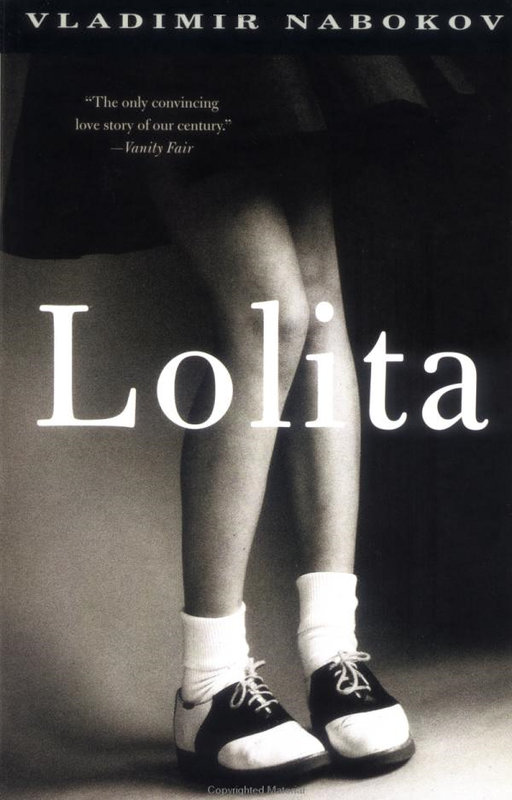
Lolita, light of my life, fire of my loins. My sin, my soul. Lo-lee-ta: the tip of the tongue taking a trip of three steps down the palate to tap, at three, on the teeth. Lo. Lee. Ta.
Would you believe I didn't know the origins, or indeed, the true meaning of the term "Lolita" until a f
ew weeks ago?

Being an English graduate student living with another English graduate student, naturally the topic of favorite books comes up. After I blabbed for about half an hour about and The Catcher in the Rye and Great Expectations, my apartment-mate mentioned that her favorite book was Lolita, by Vladimir Nabokov.

"It's so beautiful," she told me, telling me stories about how Nabokov was so obsessed with finding the perfect word order that he wrote the words of every sentence on index cards and moved the cards around until the flow was just right. On top of it, English is not Nabokov's first language, which leads to both a self-consciousness about language and a compulsion to get everything exact.

She was right, to an extent. The first paragraph was jewel-like, incredible, amazing; other parts scattered throughout were heart-breakingly beautiful. Still, the plot and the language was not sufficient to make me forget that this was a 40-year-old man having an affair with a 12-year-old girl (however nymph-like she may be). Beautiful though it may be, I couldn't move beyond the gross-out factor.

I wasn't quite getting it. I had read too fast, the plot was a little boring, and I was confused by the ending because I had missed a key clue earlier in the book. Thankfully one of my other friends has a passion for Lolita and an excellent DVD collection, which contained Adrian Lyne's version of the story.

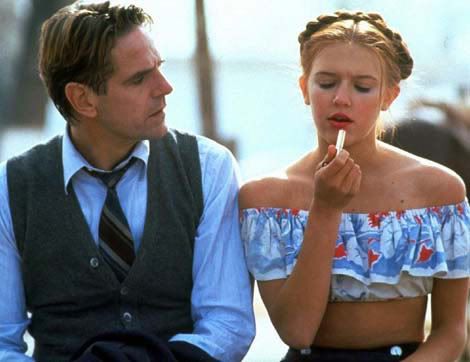
This version, made in 1997, stars a striking Jeremy Irons and a self-conciously sexual Dominique Swain. It's so very clear in this version that Lolita knows what she is doing to Humbert, that Humbert loves her rather than just lusts after her, and the complete and utter Freudian nightmare that is their relationship is painted in much clearer terms (this portrayal just helped clarify their relationship, not take away from the book's portrayal of it at all).

I cried at the end (which is nothing new to regular readers of this blog, but this time it was justified). I even forgot somehow that this older man was technically the criminal, and this manipulative, cheating shrew was ostensibily some sort of victim. All I saw was a man so in love he would do anything to keep his lover his, and at the same time a man desperate to protect his 'daughter' from the clutches of dirty old men.

Please, do read Lolita. There are some beautiful scenes that the movie doesn't bother to go into, and if nothing else, it's worth reading just to marvel at how brilliant Nabokov must be to be able to write like this in what is not his first language.

But if you find that the novel falls a little short for you, go rent the Adrian Lyne version of the film and spend two hours or so watching Dominique Swain drive Jeremy Irons out of his mind. I promise, it will bring your appreciation of the story to a whole other level.

Sunday, October 26, 2008

Reflections on Onliness

This past week I read both Only Child: Writers on the Singular Joys and Solitary Sorrows of Growing Up Solo, which made me question every action I've ever taken and wonder if it is totally textbook only child, and Washington Square, which has an only child as its heroine. Perhaps because I read Only Child first, my reading of Washington Square was necessarily tainted by the attempted psychoanalysis I now give to things related to only children. However, that aside, here are my thoughts on both.

At the obvious risk of outing myself, I am an only child and it was for this reason that I wanted to read Only Child (and because I recently made the acquaintance of one of the co-editors, another only). I hoped that I would read the book and either find commiseration in things I never realized were only child things or realize that I was what I hoped to be: a utterly not stereotypical only. (You know the type. Self-centered, spoiled, bratty. A general headache.) However, what the book ended up doing was opening up a Scylla and Charybdis of things I never thought to worry about before. For example, when you're an only, who is there to remember your family memories after your parents are gone? It's just you. Similarly, who is there to help you take care of your elderly parents? Again, just you. And who will be there to grieve when those parents are gone? Can anyone but a sibling feel the kind of pain you feel over the loss of your parents? I don't care how many cousins and other well-meaning relatives you have, I can't imagine anyone feeling the loss of either of my parents more sorely than yours truly.

That said, I also feel compelled to make everyone around me read this book. It honestly affected my life and the way I think about things and what more can you ask for in a book? There is this curtain of curiosity that exists between onlies and non-onlies. It is sheer and you can just make out the shapes on the other side, but you can never really join them, but that doesn't ever stop you from wondering what it is like over there. I think Only Child just might be the answer to pulling back that curtain a wee tad and learning a little more about the other side.

Having gotten those essays under my belt, I turned to Washington Square by Henry James. It is my second James and the official New York City Big Read this year, so it seemed like a good choice. And, as fate would have it, an utterly appropriate choice following Only Child since the heroine is an only. While my first James (The Aspern Papers) was utterly disappointing, I really enjoyed Washington Square.

The book is a close character study focusing on four characters, Dr. Sloper, Catherine Sloper, Mrs. Penniman and Morris Townsend. There is a small plot, but the characters are mainly what move the story. This works quite well since James is extremely deft at keeping up the mystery of someone's "true" character. While he left the women in the book utterly unambiguous in their character (e.g. Catherine is sweet but simple and Mrs. Penniman is foolish), the two males were much more complicated and their motives are less easy to see. And, coming at the book from the perspective of only-child-ness, Catherine was a wonderful treat. The conflicts set up by the essays in Only Child, such as the unenviable decision an only must eventually make between parents and mate, played out beautifully in Washington Square.

On the whole, I would probably recommend Washington Square if you were simply looking for something well-done and eloquent to read and Only Child if you want something to talk to your only friends about or, if you are an only, something to make you worry to no end. (Doesn't sound appealing? Better stick with the James, then.)

Since I can't seem to access my shelf at right, I give you
Next Up: Footnote: A Curious History by Anthony Grafton.

Thursday, October 23, 2008

By Way of Introduction

The thing you should know about me is that I have a problem. It's been a life-long problem, but one that has only truly manifested itself now that I have a regular paycheck. The problem is thus: I simply cannot (and I mean really cannot, even when I put my sternest stuff to the task) stop buying books. To give you an idea of the magnitude of my problem (and the detriment to my bank account), I give you the following list of books that I have purchased merely in the last week:

The Child That Books Built: A Life in Reading by Francis Spufford
Once Voice Please by Sam McBratney and Russel Ayto
Washington Square by Henry James
The Latke Who Couldn’t Stop Screaming: A Christmas Story by Lemony Snicket
The Yellow-Lighted Bookshop by Lewis Buzbee
Only Child: Writers on the Singular Joys and Solitary Sorrows of Growing Up Solo edited by Deborah Seigel and Daphne Uviller
Orientalism by Edward Said
Rob Roy by Sir Walter Scott
Footnote: A Short History by (someone whose name I can't remember but who rather wonderfully wrote an entire book about footnotes with numerous and lengthy footnotes)
Amor Est Sensus Quidam Peculiaris by Joan Walsh Anglund

Yes, indeed, the last is entirely in Latin, a language that, at my best, I am only passingly fluent in. I doubt I could ever read an entire book in Latin even after studying it for semesters on end. That alone should be indicative of my problem.

I tell you this by way of introducing you to my reading habits, clearly rather varied and often entirely unexpected even to myself, and to give you a teaser for what's coming up. Having purchased these books, I should now rightfully be compelled to read them. So here's hoping that during my tenure at this lovely blog, I'll get to write about all these books in some way or another. (And we'll just count the above comments as the extent of my writings on Amor Est Sensus Quidam Pecularis since I think we all know I shall probably never muscle my way through that one.)